

Five Decision Patterns That Accumulate Cost
The following are patterns that emerge specifically when experienced leaders are making portfolio calls under Q2 conditions.
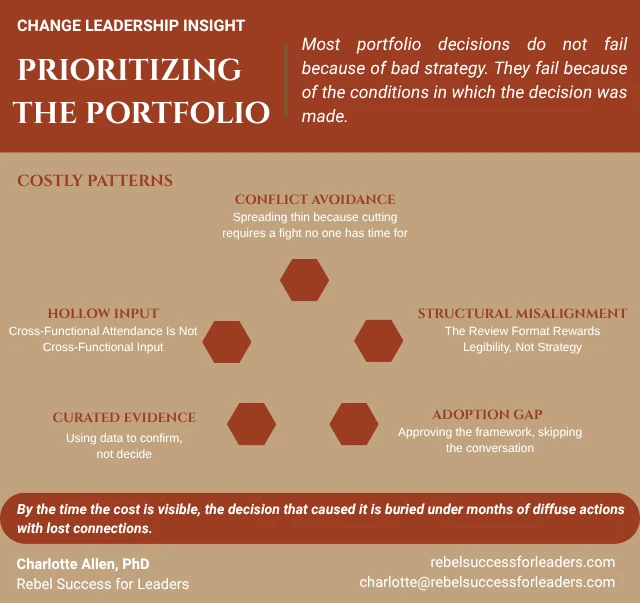
Spreading thin because cutting requires a fight no one has time for.
Resource misalignment in portfolio decisions is the result of rational conflict avoidance under time pressure, not poor planning. Killing a project, or meaningfully cutting its resourcing, requires a conversation that takes longer than the Q2 review schedule allows. So projects stay alive, each receiving enough to maintain motion and not enough to generate results. The portfolio sprawls, and the sprawl looks like a diversified risk strategy until it does not.
The Review Format Rewards Legibility, Not Strategy.
The Q2 review format rewards legibility. A project with a tight near-term ROI story makes its case in two minutes. A project building toward a capability that will matter in three years needs twenty minutes of shared context before the argument even begins, and that time is not in the agenda. So long-horizon work loses, not because leaders do not value it, but because the session structure cannot accommodate the case for it. The result is a portfolio that drifts toward what can be defended quickly, which is not the same thing as what the strategy requires.
Approving the framework, skipping the conversation.
This is the pattern with the highest downstream cost, and the one least likely to be visible at the time. A new prioritization process gets approved. The criteria are documented, the scoring rubric is distributed, and the organization moves forward with the understanding that the change has been made. What did not happen: the conversation that would have surfaced why certain teams will apply the rubric differently, which legacy assumptions will quietly override the new criteria, and where the political weight of existing projects will bend the process before it takes hold. Approving the framework and leading the change are different acts. In Q2 pressure, the first is often mistaken for the second.
Approving a new prioritization process and actually changing how people prioritize are two different acts. In Q2 pressure, the first is routinely mistaken for the second.
Using data to confirm, not decide.
Most portfolio reviews have data. Market analysis, stage-gate assessments, project scorecards, financial projections. The real question is whether the data is driving the decision or being selectively cited to support a direction already arrived at through other means. Under pressure, the latter is far more common. Leaders read for the numbers that support the direction they are inclined to take, not for the signals that would complicate it. Strengthening analytics capability matters, but only if the review process is structured to surface disconfirming data before the direction is set.
Cross-Functional Attendance Is Not Cross-Functional Input.
Transformation reviews typically include representatives from R&D, marketing, operations, and finance. Inclusion is not the same as integration. When the session is structured primarily around R&D presenting and functions responding, the cross-functional input that would most change the decision often does not reach the surface. Operations knows which projects have manufacturing dependencies that will create bottlenecks eighteen months out. Marketing has early signals about consumer trend shifts that have not made it into the project scoring. Those inputs require a different kind of session design to extract. A meeting with cross-functional attendees is not automatically a cross-functional decision.
By Q4, the Cause Is Untraceable
The decisions made in Q2 transformation reviews do not surface their costs immediately. The portfolio that looked well-balanced in April will begin to show strain by September. The projects kept alive through conflict avoidance have absorbed budget and headcount without producing milestones. The prioritization framework that was approved in Q2 is producing inconsistent outputs across teams, because approving a new process and actually changing how people work are two different things. The long-horizon work that lost the room in Q2 is now months behind, and catching up requires a resource conversation bigger than the one that was avoided in the first place.
By that point, the Q2 session is months in the past. The decisions made there have been executed against, adjusted, and partially superseded by other decisions. The connection between the Q2 call and the Q4 problem is real but invisible. Accountability is diffuse, diagnosis is difficult, and the organization is typically in the middle of preparing for the next review cycle when the full cost finally becomes legible.
This is the hidden cost of pressure-driven portfolio decisions: the lag between decision and consequence is long enough to obscure causation entirely.
By the time the cost is visible, the decision that caused it is buried under months of subsequent action. Accountability is diffuse. The connection is gone.
The Change Leadership Imperative
The conditions that make Q2 portfolio decisions go wrong are structural, and they are addressable. The review format that advantages legibility over depth can be redesigned. The cross-functional session that produces attendance without integration can be facilitated differently. The framework approval that substitutes for organizational change can be accompanied by the conversation work that makes the change real. These are precisely the conditions that change leadership consulting is designed to address.
Effective change leadership makes portfolio decisions more reliable by creating the structural conditions for honest cross-functional conversation, surfacing the data that would otherwise not reach the room, and building the organizational readiness to make a hard call and hold it through implementation. The leaders who consistently make portfolio decisions that hold up under Q4 scrutiny have mastered the process through which decisions get made.
In Q2, when the pressure to commit is highest, that process design is the variable most likely to determine whether this cycle’s decisions serve the organization or quietly undermine it.
What Looks Different in Q3
The next transformation review cycle is not far off. Leaders who recognize the pressure-decision gap in their Q2 process have a specific window to act before Q3 gates open: redesign the session structure to create space for disconfirming data, distinguish between approving a prioritization framework and leading the change it requires, and build the cross-functional conversation infrastructure that produces genuine integration rather than representative attendance. None of this requires a longer meeting. It requires a different one.
Portfolio decisions made under pressure are a choice, and the patterns that produce them are visible and changeable. The cost of repeating them is high enough to be worth the investment in changing them before the next cycle begins.