

What Gets Lost Between Intent and Execution
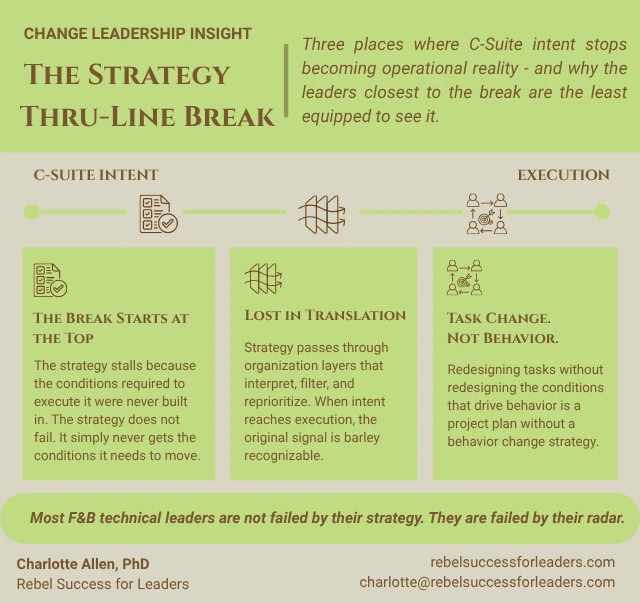
Strategy does not travel intact through an organization. It passes through layers, each of which interprets, filters, and prioritizes what it receives. By the time the VP’s intent reaches the people doing the work, it has been shaped by the urgencies, assumptions, and unspoken priorities of everyone between.
Harvard Business School professor Michael Beer documented this pattern across thirty-five years of research. In his 2020 book Fit to Compete, Beer argues that organizational silence is one of the most persistent killers of strategic execution. When people at every level cannot speak honestly about what is and is not working, senior leaders never receive an accurate picture of the gap between their strategy and the organization’s true capacity to execute it.
The strategy left the room intact. What arrived was something different.
The Task-Behavior Gap
Beer identified this failure point as far back as 1990 and documented it again with colleagues in a 2016 Harvard Business Review article: organizations focus relentlessly on what needs to change and almost never on how people need to behave differently to make that change real. Training programs are launched. Process documentation is updated. New systems are implemented. Individual behavior, shaped by the organizational roles people play and the culture those roles exist within, does not shift. Compliance happens. Adoption does not. The tasks change on paper. The thru-line breaks in practice.
This is particularly acute in F&B technical functions. R&D, Engineering, and Innovation leaders manage highly credentialed, deeply experienced teams whose professional identity is often inseparable from the way they have always worked. Redesigning tasks without redesigning the conditions that drive behavior is a project plan without a behavior change strategy.
Compliance happens. Adoption does not. The tasks change on paper. The thru-line breaks in practice.

What Needs to Shift at the Top
The third cause is the hardest to hear. The VP of R&D frustrated that her managers are not carrying out the strategy may not yet have asked what needs to change at her own level to make that possible. Beer’s research is direct on this point: when organizations reach a critical juncture in transformation, senior leaders must be willing to transform their own operating model.
Gartner research finds that 67 percent of employees do not understand their role when new growth initiatives are launched. That is a leadership design gap, not a training gap alone. When the people responsible for execution have not been given the context and space to contribute to the solution, they receive instructions without meaning. Meaningless instructions produce compliance at best and quiet disengagement at worst.
The strategy stalls because the conditions required to execute it were never built in. The strategy does not fail. It simply never gets the conditions it needs to move.
Sharpening the Radar
Beer’s thirty-five years of research point to the same conclusion every time: organizations that execute strategy well are not the ones with the best plans. They are the ones where leaders at every level, including the top, have built the conditions for honest diagnosis and genuine behavior change. In food and beverage, where transformation timelines are long and the margin for execution error is narrow, that work is not optional.
The leaders who close this gap got honest about what they could not see from where they were standing. They did it in rooms with peers who have a clear view. That is a judgment question, not a planning question. And it starts with asking: what is my organization telling me that I have not yet been willing to hear?
For senior F&B technical leaders who want to explore these dynamics with peers facing the same challenges, Rebel Success for Leaders convenes Executive Forums specifically designed for this conversation. Sign up to be notified of upcoming forums here.